How to Choose Wax Paper Food Wrapping for Your Business?
Choosing Wax Paper Food Wrapping is not simply a matter of selecting attractive paper. For a food business, the material must protect products, support brand presentation, and perform reliably during storage, transport, and service. A warm sandwich can release steam. A glazed pastry can transfer oil. A frozen item may become brittle during handling. Small details matter.
Food-packaging authority Dr. Gordon L. Robertson captures this principle clearly: “Packaging is a system, not simply a container.” That idea should guide every purchasing decision. Consider the paper’s grease resistance, moisture tolerance, folding strength, printing quality, and suitability for direct food contact. Ask suppliers for technical specifications and clear quality documentation. Check whether the wrapping works with your actual products, not only with sample materials.
Test it in real conditions.
Wrap a fresh burger for twenty minutes. Stack several pastries. Refrigerate filled wraps overnight. Look for leaks, tearing, sticking, fading, or unpleasant odors. These practical trials often reveal weaknesses that product descriptions hide. They also help compare costs more honestly, because cheaper paper may create waste and customer complaints.
Sustainability deserves careful attention, too. Recycled content, responsible fiber sourcing, and appropriate disposal guidance can strengthen a responsible packaging strategy. However, environmental claims should be verified. “Eco-friendly” is not enough. Businesses should review supplier evidence and local food-contact requirements before making public claims. There is no perfect wrapping solution. A paper that suits bakery items may fail with oily street food. The best choice balances performance, appearance, safety, cost, and honest communication.
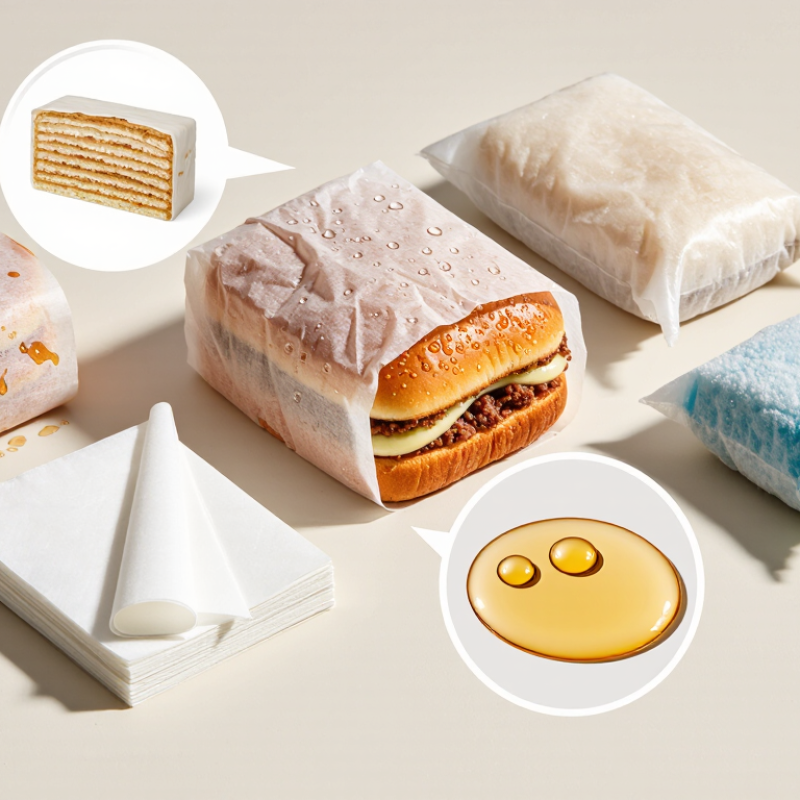
Define Food-Contact Compliance: FDA 21 CFR 176.170 and EU 1935/2004
Choosing wax paper is not only a question of grease resistance or attractive folding. Food-contact compliance must match the food, temperature, contact time, and packaging process.
In the United States, FDA 21 CFR 176.170 covers paper and paperboard contacting aqueous or fatty foods.
It does not mean every wax paper product is automatically FDA compliant. Ask for the exact food types and conditions of use. Hot pastries, oily meats, and refrigerated bakery items create different migration risks. The FDA evaluates permitted components and their intended applications. A supplier should provide composition details, test reports, and supporting compliance statements.
Documentation matters.
In Europe, Regulation (EC) 1935/2004 requires materials to avoid harmful migration and unacceptable changes in food taste, smell, or composition.
Paper materials may also depend on national requirements because no single EU measure fully harmonizes them. Request a Declaration of Compliance and evidence of good manufacturing practice under Regulation (EC) 2023/2006. According to the Flexible Packaging Association’s 2024 industry report, U.S. flexible packaging sales reached about 39.5 billion dollars in 2023. That scale increases sourcing pressure, but volume never replaces testing. I have seen buyers rely on “food grade” wording alone. It sounds reassuring, yet it is incomplete. Verify coating chemistry, wax transfer, printing inks, recycled content, and migration testing for the actual application.
Keep one unresolved question visible: does the paper remain compliant after storage, folding, and heat exposure?
Set Paper Specifications: Basis Weight, GSM, Caliper, and Roll Dimensions
How to Choose Wax Paper Food Wrapping for Your Business?
Set specifications before requesting samples. Basis weight, measured in GSM, shows how much paper weighs per square metre. A 40 GSM sheet weighs 40 grams per square metre. For light bakery items, 30–40 GSM may work. Greasy or warm foods often need 45–60 GSM, depending on wax coverage and folding stress. ISO 536 and TAPPI T 410 provide recognized methods for measuring basis weight. These standards make supplier comparisons less subjective.
Caliper measures thickness, usually in microns. It affects stiffness, tear resistance, and the paper’s hand feel. Do not assume higher caliper means better protection. A dense 45 GSM sheet can outperform a bulky 55 GSM sheet. Roll dimensions also matter. Record web width, roll length, core diameter, and maximum roll diameter. For example, a 500-metre roll with a 300-millimetre web covers 150 square metres. FAO forestry statistics report global paper and paperboard production above 400 million tonnes annually, so small specification errors can become large material costs. Smithers’ 2024 packaging outlook also highlights downgauging and fit-for-purpose design as practical efficiency measures.
Tips: Test three GSM levels with the same wax formulation. Measure caliper at five points across the roll. Check the edges, not only the centre. Calculate waste from your actual cutting pattern. I once accepted a wider roll for a lower unit price; trimming losses erased the saving. That mistake still deserves review.
How to Choose Wax Paper Food Wrapping for Your Business?
Recommended paper specifications by food-wrapping application. Basis weight is shown in GSM, while caliper and roll width are provided as practical purchasing references.
| Application |
Basis Weight / GSM |
Typical Caliper |
Common Roll Width |
Typical Roll Length |
| Bakery and pastry wrapping |
35–45 g/m² |
40–55 μm |
300–600 mm |
100–300 m |
| Sandwich and deli wrapping |
45–55 g/m² |
50–65 μm |
400–800 mm |
150–400 m |
| Takeaway and high-grease foods |
55–65 g/m² |
60–75 μm |
500–1,000 mm |
200–500 m |
Higher GSM and caliper generally improve stiffness, handling strength, and resistance to grease migration. Choose the roll width and length according to the wrapping equipment, package size, and expected production volume. Always confirm food-contact compliance and performance with the final paper specification.
Select Wax Types: Paraffin, Soy, and Beeswax by Temperature and Food Use
Choosing wax paper starts with temperature, fat, and contact time. Paraffin suits cold sandwiches, bakery liners, and short-term wrapping. Typical paraffin coatings soften around 120–150°F, depending on formulation. They can fail beside hot fillings. The FDA Food Code (2022) sets cold holding at 41°F or below and hot holding at 135°F or above. Wax paper is not an oven liner. That mistake is common.
Soy wax may fit chilled foods, cookies, and room-temperature bakery service. Its performance varies with coating weight, blends, and paper porosity. Do not assume “plant-based” means heat-resistant. Beeswax usually forms a firmer coating and suits bread, cheese, and dry snacks. It may handle warm handling better than some soy coatings. However, its natural aroma can transfer to delicate foods. Not always desirable.
Test the actual wrap with your menu. Record surface temperature, oil bleed, seal strength, and contact time. Test it. For greasy foods, run a 24-hour trial and inspect translucent spots after cooling. The FDA temperature limits provide a useful safety boundary, not a complete packaging specification. Packaging reports also warn that coating chemistry and food conditions influence migration performance. Ask suppliers for food-contact documents and tested temperature limits. My practical rule is simple: choose paraffin for cold speed, soy for a lighter trial, and beeswax when firmness matters. Recheck that rule with real food.
How to Choose Wax Paper Food Wrapping for Your Business? — Select Wax Types: Paraffin, Soy, and Beeswax by Temperature and Food Use
Selection note: Melting ranges are typical values and can vary with wax grade,
additives, coating weight, paper structure, and manufacturing process. Before commercial use,
verify food-contact compliance, grease resistance, sealing performance, odor transfer, and the
maximum temperature stated for the finished wrapping paper. Do not assume that wax-coated paper
is oven-safe or microwave-safe without explicit testing and labeling.
Verify Production Quality: ISO 536, ASTM D1894, and Migration Test Results
When choosing wax paper food wrapping, production quality deserves more attention than surface appearance. Smithers’ The Future of Global Packaging to 2028 valued the worldwide packaging market at approximately US$1.2 trillion in 2023. That scale makes weak quality control expensive.
Request ISO 536 test results for grammage, measured in grams per square metre. Grammage affects stiffness, tearing, and wax distribution. Compare the report with your purchase specification, not only the average value. A sheet can feel thick yet vary across the roll. Check sampling locations and production dates. Do not guess.
ASTM D1894 results show static and kinetic coefficients of friction. These values help predict feeding, stacking, and machine slippage. Lower friction is not always better. Your equipment may need controlled grip. Ask for test speed, load, surface condition, and test direction. Migration reports require equal care. Request the tested simulants, contact time, temperature, detection limits, and results in mg/dm² or mg/kg. The protocol must match the food type and destination market. EU food-contact requirements, including Regulation (EU) No 10/2011 where applicable to plastic components, should not be copied blindly for paper-based structures. Paper, wax, inks, and coatings may need separate assessment. One missing attachment can change the decision. Examine the full report, including non-detect results and deviations.





 Jimmy
Jimmy Eric
Eric